Prof. Dr. Pedro Montoya
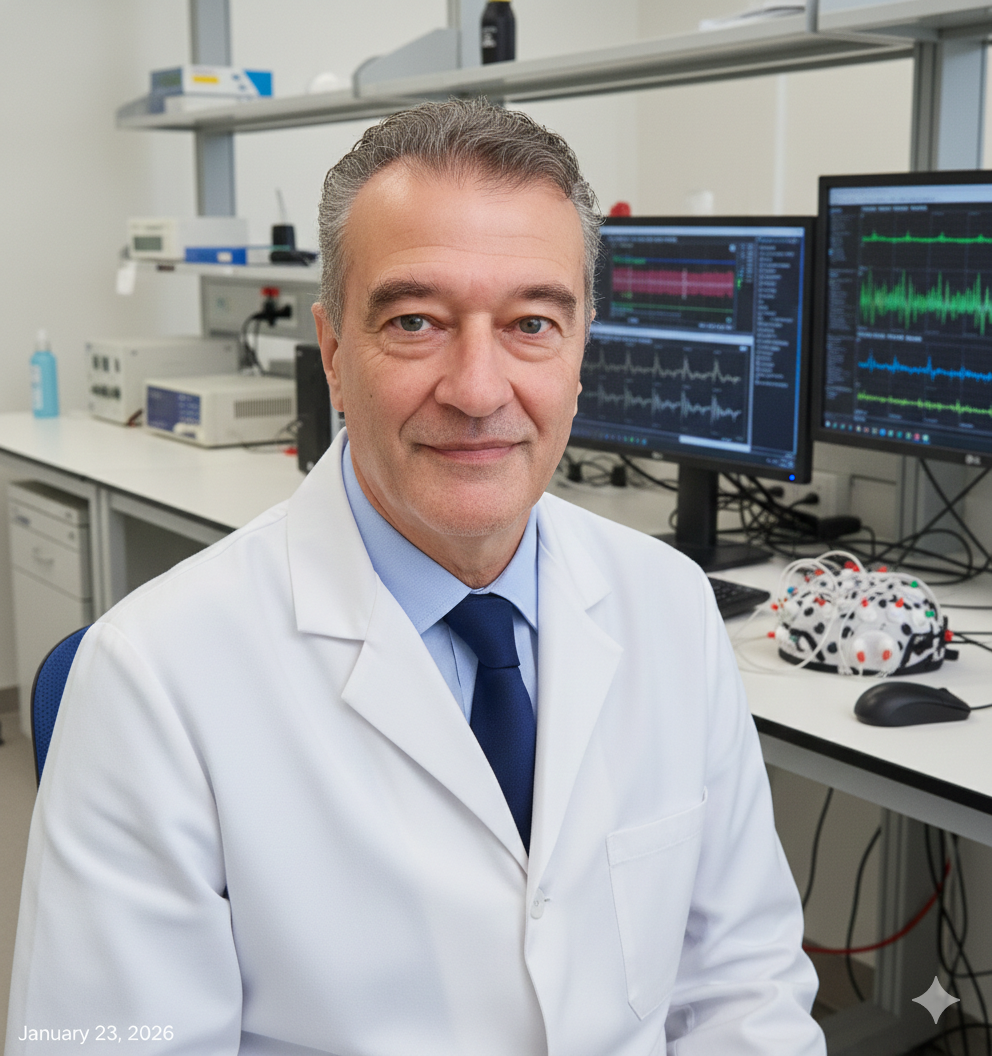
Prof. Dr. Pedro Montoya
Pedro Montoya is a psychologist and neuroscientist specializing in the neurobiology of chronic pain and the brain networks underlying emotion and cognition. He obtained his Psychology degree from Universidad Complutense de Madrid (1986) and a PhD from the University of Munich (1993). His career includes research and teaching in Spain, Germany, and the Americas, with a focus on EEG and fMRI markers of pain-related processing and neuromodulation approaches such as neurofeedback and electrical brain stimulation.
Academic Education
- ✓Psychology Degree, Universidad Complutense de Madrid (1986)
- ✓PhD in Psychology, University of Munich (1993)
Areas of Expertise
- ▪Chronic pain neurobiology and brain network dynamics
- ▪EEG and fMRI biomarkers of pain, emotion, and cognition
- ▪Neuromodulation: neurofeedback, electrical brain stimulation
- ▪Translational research in fibromyalgia, rheumatoid arthritis, and cerebral palsy
Collaborations & Roles
Collaborates internationally on projects examining pain-related brain dynamics using fMRI and EEG, including work with teams led by Dante R. Chialvo (Argentina), José Garcia Vivas Miranda (Brazil), and Abrahao Fontes Baptista (Brazil). He has broad teaching experience across Behavioral and Cognitive Neuroscience, Psychophysiology, and Physiological Psychology, and currently serves as a Visiting Professor at UFABC (Brazil). He co-founded BIPSIN SL, a technology-based start-up in health and behavioral research.
Academic Contact
- University of the Balearic Islands (UIB), IUNICS – Palma, Spain
- Phone: (+34) 971 17 2646
- Email: pedro.montoya@uib.es
Research & Publications
Chronic Pain & Brain Activity
Longstanding line of work analyzing neural activity and connectivity in chronic pain using EEG and fMRI, investigating how pain alters brain processing and how cognitive and affective factors modulate these changes.
Neuromodulation & Translational Work
Ongoing projects testing neuromodulatory techniques—such as neurofeedback and non-invasive electrical stimulation—to relieve pain and target maladaptive plasticity, bridging clinical populations and basic neuroscience.
Selected Publications on Neuromodulation
- •Winterholler, C., Coura, M.H., & Montoya, P. (2025). Clinical, neurophysiological and neurochemical effects of non-invasive electrical brain stimulation in fibromyalgia syndrome—a systematic review and meta-analysis. Frontiers in Pain Research, 6, 1593746. [Open Access]
- •Terrasa, J.L., Winterholler, C., Montoya, P., & Juan, A. (2025). Modulatory effects of transcranial direct current stimulation on sensory gating in Fibromyalgia Syndrome. Frontiers in Psychology, 15, 1607317. [Open Access]
- •Terrasa, J.L., Winterholler, C., & Montoya, P. (2023). Modulatory effects of anodal transcranial direct current stimulation (tDCS) on somatosensory gating in patients with fibromyalgia. IBRO Neuroscience Reports, 14, 1525-7. [Open Access]
- •Montoro, C.I., Winterholler, C., Terrasa, J.L., & Montoya, P. (2021). Somatosensory gating is modulated by anodal transcranial direct current stimulation. Frontiers in Neuroscience, 15, 651253. [Open Access]
- •Terrasa, J.L., Alba, G., Cifre, I., Rey, B., Montoya, P., & Muñoz, M.A. (2019). Power spectral density and functional connectivity changes due to a sensorimotor neurofeedback training. Neural Plasticity, 2019, 7647204. [Open Access]
- •Cosmo, C., Baptista, A.F., de Araújo, A.N., et al. (2015). A randomized, double-blind, sham-controlled trial of transcranial direct current stimulation in attention-deficit/hyperactivity disorder. PLOS ONE, 10(8), e0135371. [Open Access]